HomeRomeJewish Rome Before and Beyond the Ghetto
Jewish Rome Before and Beyond the Ghetto
Rome · Walking Tour

Jewish Rome Before and Beyond the Ghetto

2 hrsWalk
3.1 kmDistance
10Stops
24Chapters

About this route

Imagine tracing how a community older than imperial Rome endured confinement and remained Roman, from the imposed Ghetto at Piazza Mattei through the names memorialized at Largo 16 October 1943 and the defiant dome of the Great Synagogue to Vicolo dell’Atleta, where medieval walls reveal Jewish life across the Tiber five centuries before the Ghetto existed.

🎧 Narrated audio tour⬇️ Works offline🌐 English📍 10 stops
Narrated by
rrawi
English

Stops on the route

10 stops · 24 chapters
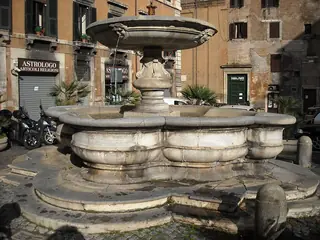
Piazza Mattei & Turtle Fountain
01

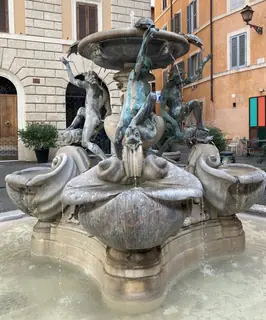
Piazza Mattei & Turtle Fountain

This elegant square introduces the full two-thousand-year arc of Jewish Rome and establishes the Ghetto as an imposed chapter rather than the community’s…

~10 min here·2 chapters
The Pope Who Drew a Line Around a PeopleFree chapter

Pope Paul IV created Rome's Jewish Ghetto in 1555, confining a community that had already lived in Rome for over 1,700 years.

0:000:00
What the Turtle Fountain Doesn't Tell YouFree chapter

The Turtle Fountain, completed in 1588, sits in elegant contrast to the coercive history of the ghetto just steps away — and its famous turtles arrived 70 years after the fountain itself.

0:000:00
Circolo I Ragazzi del '48 (Zi Raimondo)
02

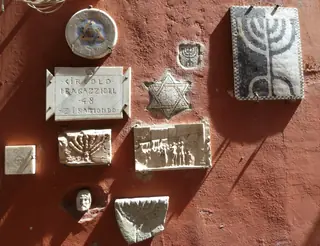
Circolo I Ragazzi del '48 (Zi Raimondo)

The former Jewish cultural club turns wartime persecution into the individual story of boxer Lazzaro Anticoli, reinforced by memorial symbols and nearby…

~10 min here·1 chapters
The Man This Building Was Made to Remember

The Circolo I Ragazzi del '48 at Via della Reginella 15 was a community memory space dedicated to Roman Jewish survivors and victims of the Nazi occupation, anchored by the story of one man — Lazzaro Anticoli, known as Bucefalo.

Piazza delle Cinque Scole
03

Piazza delle Cinque Scole

The vanished Five Synagogues reveal how distinct Roman, Sicilian, and Iberian Jewish traditions survived together under the Ghetto’s restrictions.

~5 min here·2 chapters
Five Congregations Forced Under One Roof

A 1555 papal decree forced five distinct Jewish congregations — each with its own rite and origin — into a single shared building on this square, making visible both the diversity and the confinement of Roman Jewish life.

The Architect, the Marble, and the Vanished Building

The fountain now dominating this square was built from stone salvaged from an ancient Roman temple, designed by the same architect who created the Turtle Fountain — and the building that gave the square its name was demolished only after a replacement was finally built.

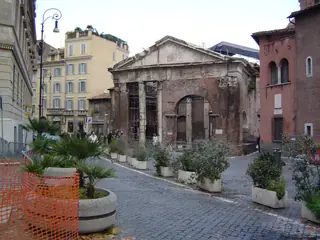
Portico d'Ottavia
04

Portico d'Ottavia

Here homes, shops, and a fish market occupied ancient ruins, making Jewish adaptation to Rome’s accumulated historical layers physically visible.

~5 min here·3 chapters
A Church Inside a Roman Monument

The Portico d'Ottavia was not preserved as a monument — it was absorbed into daily life, with a medieval church, a fish market, and homes built directly into its ruins.

The Fish Market in the Ruins

From the Middle Ages through the late 19th century, a fish market operated inside the ruins — the church's very name, Sant'Angelo in Pescheria, records it.

Jewish Life Inside Imperial Ruins

The Portico d'Ottavia stood at the center of the neighborhood that became the Roman Ghetto in 1555 — Jewish Romans lived literally inside the remains of Imperial Rome.

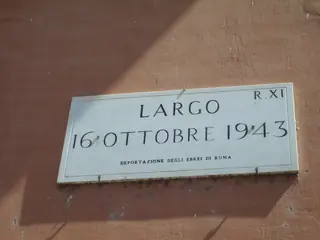
Largo 16 October 1943
05

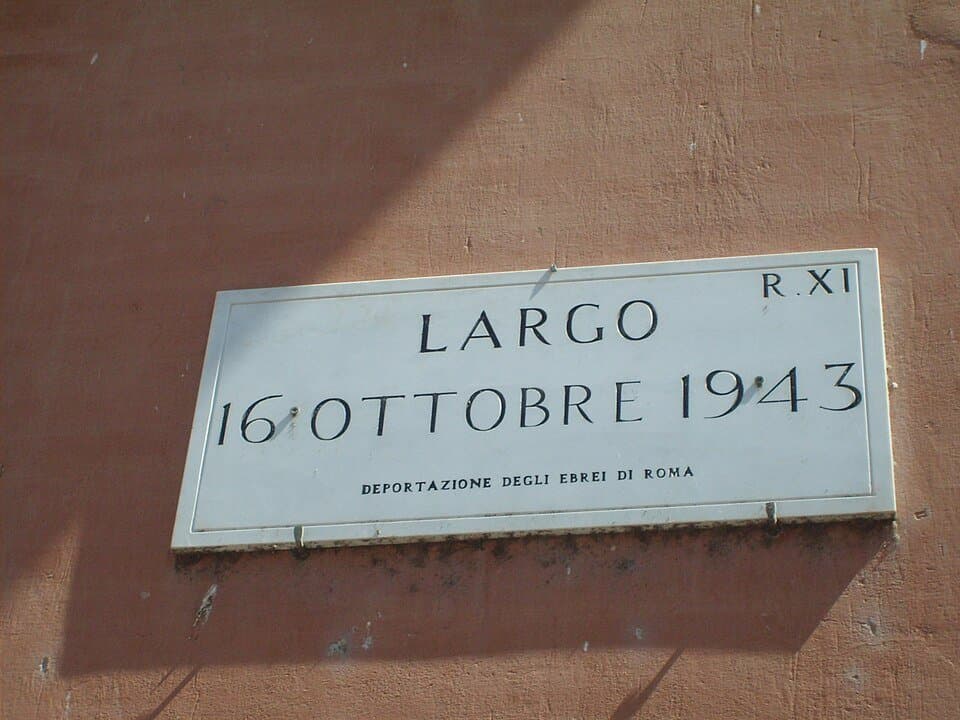
Largo 16 October 1943

This square confronts the raid of 16 October 1943, while nearby Stolpersteine restore individual names to the more than one thousand Roman Jews deported.

~15 min here·2 chapters
One Morning That Changed Everything

The raid of 16 October 1943 began before dawn on a Jewish festival, targeting homes across the former ghetto with military precision.

Names in the Pavement — Memory at Street Level

The Stolpersteine embedded in nearby pavements transform the abstract number of 1,022 deportees into individual people with names, addresses, and ages.

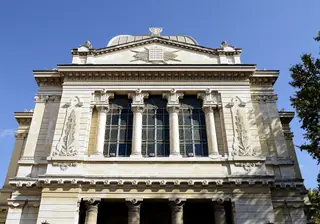
Great Synagogue of Rome
06

Great Synagogue of Rome

Its conspicuous dome embodies the Jewish community’s transformation from enforced invisibility to public civic presence after emancipation in 1870.

~15 min here·3 chapters
Why Does This Dome Look So Different?

The Great Synagogue's square-based aluminium-clad dome was a deliberate architectural statement of visibility on Rome's skyline, chosen after centuries of forced invisibility.

Tearing Down the Past to Build a Future

The late-nineteenth-century redevelopment of Rome demolished much of the old Ghetto physically, and the community responded by choosing to build a monumental synagogue in the same neighborhood.

Visibility Claimed, Then Threatened Again

The Great Synagogue's opening in 1904 represented a peak of civic confidence, but the same community would face fascist racial laws in 1938 and the Nazi raid of October 1943 — making the building a witness to the full arc of emancipation and persecution.

Tiber Island & Pons Fabricius
07

Tiber Island & Pons Fabricius

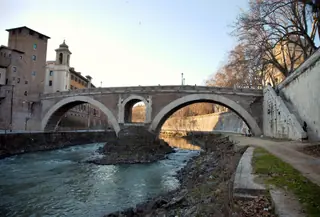
The ancient river crossing serves as the tour’s historical hinge, leading from the documented Ghetto back toward the older Jewish neighborhoods of Trastevere.

~10 min here·2 chapters
The Bridge That Connects Two Worlds

Pons Fabricius, built in 62 BCE, is one of Rome's oldest bridges still in use, and its direct link to the Jewish Ghetto earned it the name Pons Iudaeorum — the Bridge of the Jews.

Before the Ghetto — Jewish Rome's Deeper Roots

Jewish presence in Rome predates the Ghetto by more than 1,700 years; crossing this bridge is a way to move backwards through that longer story.

Vicolo dell'Atleta & Ancient Synagogue
08

Vicolo dell'Atleta & Ancient Synagogue

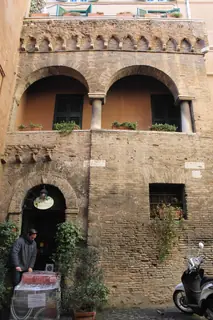
Its medieval fabric, Hebrew traces, possible mikveh, and association with Nathan ben Yehiel recover a Jewish Trastevere largely absent from modern memory.

~5 min here·2 chapters
The Column That Hides a Name

A column in this lane bears Hebrew characters linked to Nathan ben Yehiel, an 11th-century Jewish scholar — physical proof that a Jewish neighborhood existed here centuries before the Ghetto.

What the Street Name Conceals

The modern name of this lane — commemorating a Roman sculpture — has quietly buried the Jewish history that the lane itself still physically contains.

Basilica di Santa Maria in Trastevere
09

Basilica di Santa Maria in Trastevere

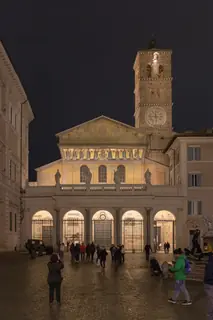
This ancient Christian landmark provides essential context for the shared medieval Trastevere in which Jewish and Christian communities inhabited the same…

~25 min here·5 chapters
What Stood Here Before the Church

The site of Santa Maria in Trastevere has been a gathering place since at least the 3rd century CE, with roots in an even older legend tied to 38 BCE.

How Innocent II Rebuilt His Legacy in Stone

The present basilica was rebuilt between 1140 and 1143 by Pope Innocent II, a man who spent eight years of his papacy as a refugee before finally returning to Rome.

The Columns That Came From an Emperor's Bathhouse

The 22 granite columns dividing the nave from the aisles were salvaged from the Baths of Caracalla, built by an emperor who murdered his own brother.

🔓
Unlock 2 more chapters in the app
Get the app
Piazza Trilussa
10

Piazza Trilussa

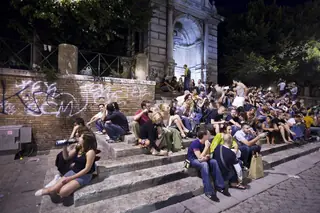
This lively modern square offers a fitting conclusion across the river, emphasizing the continuity of Jewish Rome beyond the history of confinement and…

~8 min here·2 chapters
The Poet Who Spoke for the Street

Trilussa was a Roman dialect poet whose sharp, satirical voice turned ordinary speech into literature — and his monument now marks the square named after him.

A Fountain Moved, a City Remade

The Acqua Paola fountain in this square was originally built in 1613 to supply the left bank of the Tiber, then dismantled in 1870 during embankment works and reassembled here in 1898 — its incomplete reconstruction a record of how modern infrastructure reshaped Rome's riverfront.

+ 3 more stops in the app

FAQ

How long does this route take?

The audio narration is 45:09 in total. If you pause to look around and take photos, budget 2 hrs. You can pause and resume any time — including the next day.

Is the tour narrated in my language?

This version is narrated in English by rrawi. Other language versions may be available — check the language switcher on this page.

Can I listen without an internet connection?

Yes. This self-guided audio tour works fully offline — download it in the rrawi app before you set off, and GPS automatically triggers the next chapter as you walk. No signal needed.

Do I have to start from the first stop?

No — you can start or jump to any stop in the app. The route works in order, but each stop stands on its own if you need to skip.

What does the free part include?

Different tours offer different free preview chapters depending on the content. Download the rrawi app and subscribe to a City Pass to unlock all 24 chapters and experience the full route.

Ready to walk Rome?

Download rrawi and let rrawi walk with you.

Walk with the app
First chapter at each stop is free
Get the app