HomeFlorenceFlorence Conquered: The Medici Family's Masterful Ascent · 1 Day
Florence · Walking Tour

Florence Conquered: The Medici Family's Masterful Ascent · 1 Day

11 hrsWalk
2.0 kmDistance
9Stops
43Chapters

About this route

Imagine watching a banking family quietly acquire a republic, from Cosimo de' Medici's calculated restraint at Palazzo Medici Riccardi through dynastic patronage at San Lorenzo and the political rewriting of Piazza della Signoria to the moment Cosimo I crosses the Arno into Pitti Palace behind an elevated private corridor.

🎧 Narrated audio tour⬇️ Works offline🌐 English📍 9 stops
Narrated by
rrawi
English

Stops on the route

9 stops · 43 chapters
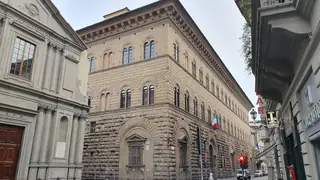
Palazzo Medici Riccardi
01

Palazzo Medici Riccardi

MUST INCLUDE: Cosimo de Medici's palace, private banking power made architectural, Magi Chapel; core Medici narrative opening

~1 hr here·5 chapters
The Bank That Built a Dynasty

Cosimo de' Medici transformed the Medici family from prominent bankers into the de facto rulers of Florence, and this palace was the physical headquarters of that transformation.

Why Cosimo Chose Restraint Over Grandeur

Cosimo deliberately chose a restrained architectural design — rejecting Brunelleschi's more ostentatious proposal — because overt displays of dominance would have been politically dangerous in a republic.

The Courtyard at the Center of Power

The interior courtyard — with its round arches, slender Corinthian columns, and antique gem medallions — was the true heart of the Medici residence, where business, politics, and culture all converged.
🔓
Unlock 2 more chapters in the app
Get the app
San Lorenzo Complex
02

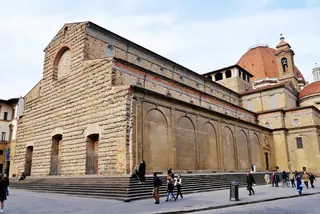
San Lorenzo Complex

MUST INCLUDE: Medici parish church, Brunelleschi architecture, family identity and patronage narrative

~2 hrs here·4 chapters
Giovanni di Bicci and the Church He Claimed

Giovanni di Bicci de' Medici used his banking fortune to fund the first great Renaissance church in Florence, transforming San Lorenzo into the Medici family's spiritual headquarters — a calculated act of civic identity, not just piety.

Brunelleschi's Mathematical Vision Inside the Basilica

Brunelleschi designed San Lorenzo's interior as a precisely proportioned system — grey pietra serena stone against white plaster, a 60-meter nave — that made mathematical order feel like spiritual calm, establishing the visual grammar of Renaissance architecture.

The Old Sacristy and Where the Patriarch Is Buried

The Old Sacristy, Brunelleschi's purest early work decorated by Donatello, was built as Giovanni di Bicci's funerary chapel — the first statement that San Lorenzo was not just a neighborhood church but a Medici dynastic monument.

🔓
Unlock 1 more chapters in the app
Get the app
Medici Chapels
03

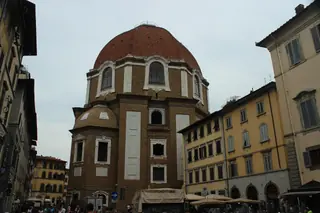
Medici Chapels

MUST INCLUDE: dynastic burial, Michelangelo's New Sacristy, Chapel of the Princes; princely ambition made stone

~1 hr here·5 chapters
The Puzzle Inside San Lorenzo's Burial Complex

The Medici Chapels contain two radically different spaces built a century apart, each expressing a completely different vision of what the Medici were — or wanted to be.

Michelangelo's Commission — and His Complicated Loyalty

Michelangelo designed the New Sacristy while caught between genuine republican sympathies and unavoidable Medici patronage, and the commission came from a pope who was himself a Medici.

What Michelangelo Actually Carved — and Why It's Strange

The allegorical tomb sculptures in the New Sacristy are deliberately idealized rather than realistic, and their meaning operates on a philosophical rather than biographical level.

🔓
Unlock 2 more chapters in the app
Get the app
Laurentian Library
04

Laurentian Library

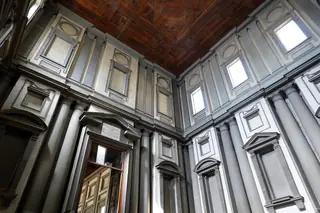
MUST INCLUDE: Michelangelo as architect, compressed vestibule, staircase, manipulation of classical rules

~45 min here·5 chapters
The Letter That Built a Staircase

Michelangelo designed the Laurentian Library's revolutionary vestibule and staircase for Medici papal patrons, but left Florence in 1534 before finishing it — completing the design by letter and clay model from Rome decades later.

When Clement VII Wanted a Monument

Pope Clement VII — born Giulio de' Medici — commissioned the library in 1519 specifically to house the Medici manuscript collection and to plant a permanent symbol of Medici cultural authority in Florence.

Architecture That Breaks Its Own Rules

Michelangelo deliberately inverted classical conventions in the vestibule — columns recessed into walls, blind windows, tapering pilasters — creating what would become the founding statement of Mannerist architecture.

🔓
Unlock 2 more chapters in the app
Get the app
Piazza della Signoria
05

Piazza della Signoria

MUST INCLUDE: republican institutions, Medici exile and return, Savonarola, public legitimacy; essential political counterpoint

~30 min here·5 chapters
The Piazza Before the Medici Owned It

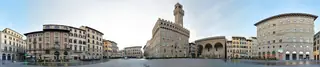
Piazza della Signoria was built as the physical headquarters of Florentine republican government, and its design expressed civic power, not dynastic power.

Savonarola and the Republic's Breaking Point

After the Medici were expelled in 1494, Florence's attempt at a purified republic collapsed into theocratic terror, ending with an execution in this very square — the same spot where the bonfires had blazed.

The Medici Return — and Rewrite the Square

When Cosimo I took power in 1537, he transformed the piazza from a symbol of republican self-rule into a stage for dynastic authority, using art as political messaging.

🔓
Unlock 2 more chapters in the app
Get the app
Palazzo Vecchio
06

Palazzo Vecchio

MUST INCLUDE: republic headquarters transformed into ducal palace by Cosimo I; the physical embodiment of republican-to-ducal transition

~2 hrs here·5 chapters
Arnolfo di Cambio and the Fortress of the Republic

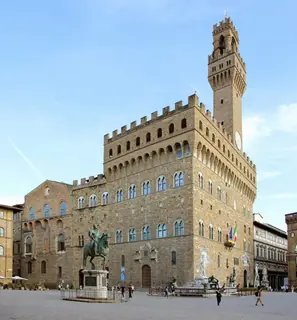
The Palazzo Vecchio was built as a deliberate symbol of civic republican power, its asymmetric tower a consequence of laws that protected private property.

Savonarola and the Republic's Burning Moment

Between the first and second Medici periods, Palazzo Vecchio was the seat of a theocratic republic under Savonarola — and the piazza in front of it became the stage for both his rise and his destruction.

Cosimo I and the Overwriting of a Republic

When Cosimo I moved into Palazzo Vecchio in 1540, he physically transformed a republican civic hall into a ducal palace — a deliberate act of symbolic erasure.

🔓
Unlock 2 more chapters in the app
Get the app
Uffizi Gallery
07

Uffizi Gallery

MUST INCLUDE: Vasari's government offices, dynastic collecting, birth of the modern museum; Medici cultural consolidation

~2 hrs here·5 chapters
Cosimo I's Blueprint for Bureaucratic Control

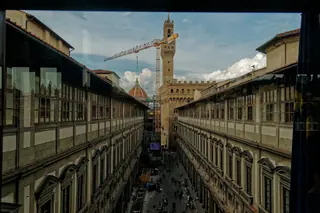
The Uffizi was built as a government office complex — a deliberate tool of political centralization — not as a museum.

Vasari — The Man Who Built the Frame

Giorgio Vasari was simultaneously Cosimo's architect, court painter, and the man who invented art history as a discipline — the Uffizi building is only one layer of his legacy.

Francesco I and the Birth of the Gallery

It was Francesco I, Cosimo's son, who converted the Uffizi's top floor into Europe's first purpose-designed art gallery space — a deliberate act of dynastic display.

🔓
Unlock 2 more chapters in the app
Get the app
Vasari Corridor
08

Vasari Corridor

MUST INCLUDE: controlled movement between government and palace, physical separation of rulers from the street

~1 hr here·4 chapters
What Cosimo I Built Above the City

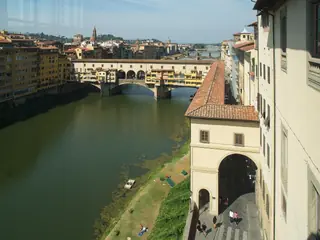
The Vasari Corridor was Cosimo I's private elevated highway — a deliberate physical separation of the ruler from the street — running nearly a kilometer from the Palazzo Vecchio to the Palazzo Pitti.

How Vasari Solved the Ponte Vecchio Problem

To cross the Ponte Vecchio, Vasari constructed a new upper storey directly on top of the medieval bridge's existing shops — a feat of audacious urban engineering completed at extraordinary speed.

The Church Window That Kept Cosimo Separate

The corridor passes through the Church of Santa Felicita, where a private window allowed the Medici to attend Mass without entering the church or mixing with the public — a physical expression of dynastic separation from ordinary life.

🔓
Unlock 1 more chapters in the app
Get the app
Pitti Palace & Boboli Gardens Complex
09

Pitti Palace & Boboli Gardens Complex

MUST INCLUDE: dynasty crossing the Arno, courtly grand-ducal power, final chapter of Medici narrative

~2 hrs here·5 chapters
Luca Pitti's Rivalry and the Palace He Never Finished

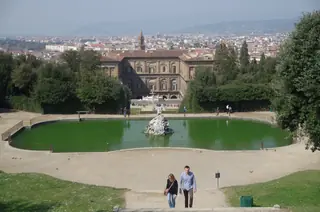
The Pitti Palace was built as a deliberate act of one-upmanship against the Medici — and ended up becoming the Medici's grandest home.

Eleonora di Toledo Buys the Palace Herself

Eleonora di Toledo — Cosimo I's wife — purchased the Pitti Palace in 1549 using her own money, an unusual act of independent female property ownership that set the entire Medici transformation in motion.

Ammannati's Courtyard and Mannerist Power

Bartolomeo Ammannati's interior courtyard — three stories of rusticated arches in stacked classical orders — is one of the defining works of Mannerist architecture, and it turned the palace's rough exterior into a stage for Medici court life.

🔓
Unlock 2 more chapters in the app
Get the app
+ 2 more stops in the app

FAQ

How long does this route take?

The audio narration is 90:13 in total. If you pause to look around and take photos, budget 11 hrs. You can pause and resume any time — including the next day.

Is the tour narrated in my language?

This version is narrated in English by rrawi. Other language versions may be available — check the language switcher on this page.

Can I listen without an internet connection?

Yes. This self-guided audio tour works fully offline — download it in the rrawi app before you set off, and GPS automatically triggers the next chapter as you walk. No signal needed.

Do I have to start from the first stop?

No — you can start or jump to any stop in the app. The route works in order, but each stop stands on its own if you need to skip.

What does the free part include?

Different tours offer different free preview chapters depending on the content. Download the rrawi app and subscribe to a City Pass to unlock all 43 chapters and experience the full route.

Ready to walk Florence?

Download rrawi and let rrawi walk with you.

Walk with the app
First chapter at each stop is free
Get the app