HomeFlorenceMichelangelo and the Making of Florence
Michelangelo and the Making of Florence
Florence · Walking Tour

Michelangelo and the Making of Florence

8 hrsWalk
2.7 kmDistance
7Stops
32Chapters

About this route

Imagine deciding whether Florence created Michelangelo or Michelangelo created Florence, from the original David and unfinished Prisoners at the Galleria dell'Accademia through the pressured Medici commissions of the New Sacristy and Laurentian Library to the civic afterlife of his image in Piazza della Signoria, Casa Buonarroti, Santa Croce, and the bronze David overlooking the city from Piazzale Michelangelo.

🎧 Narrated audio tour⬇️ Works offline🌐 English📍 7 stops
Narrated by
rrawi
English

Stops on the route

7 stops · 32 chapters
Galleria dell'Accademia
01

Galleria dell'Accademia

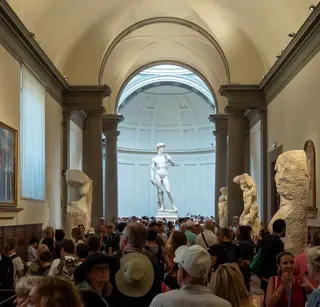
Selected as the essential starting point for the original David, its intended cathedral setting, and the unfinished Prisoners that expose Michelangelo's marble…

~2 hrs here·4 chapters
The Ruined Block Nobody Else Would TouchFree chapter

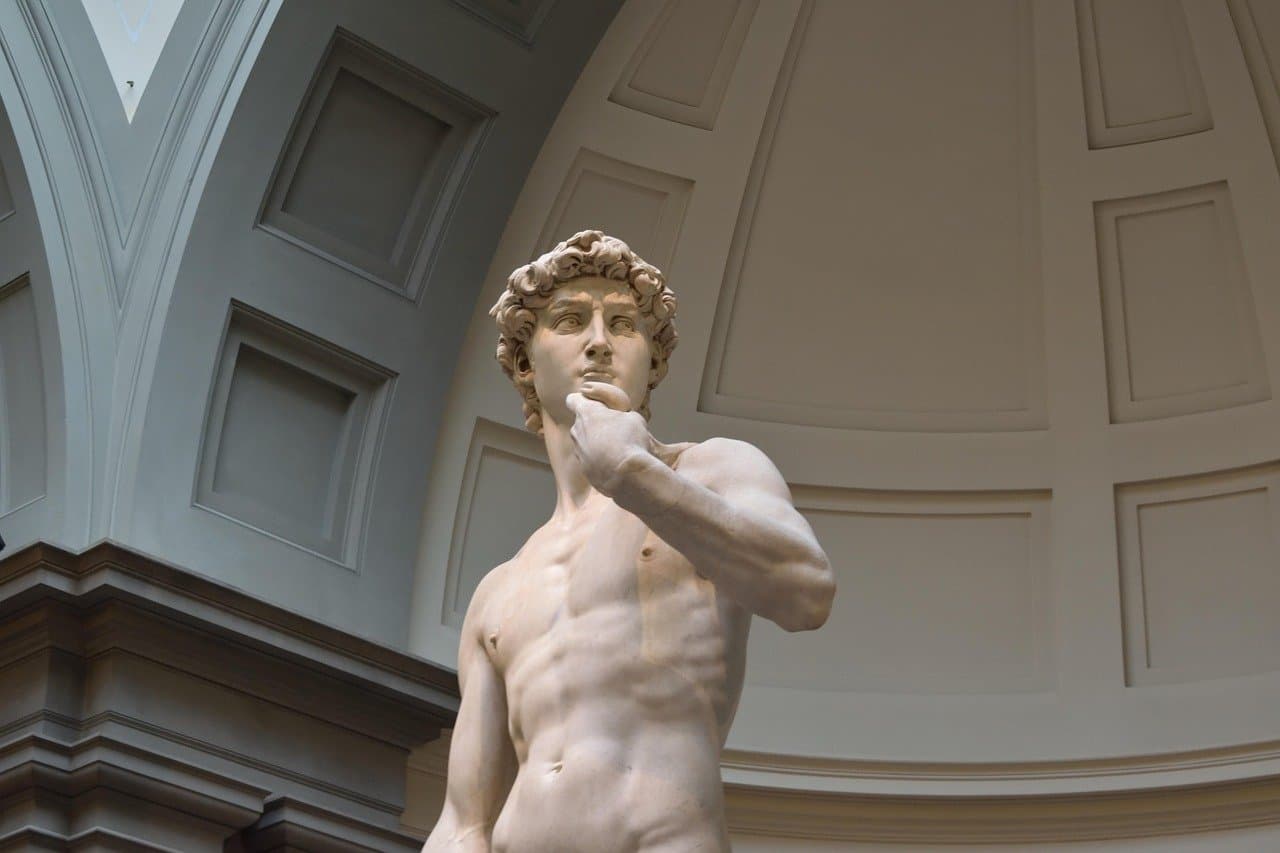
The David began not as a triumph but as a salvage job — a block of marble two sculptors had already abandoned, handed to a 26-year-old on the strength of audacity alone.

0:000:00
What the David Was Originally Meant to BeFree chapter

The David was commissioned for a cathedral buttress as a religious figure — its transformation into a republican civic symbol happened after the work was complete, through a political decision Michelangelo didn't make alone.

0:000:00
Standing in Front of the David Itself

Up close, the David reveals Michelangelo's psychological intensity and technical mastery — a figure caught in the moment before action, not after.
🔓
Unlock 1 more chapters in the app
Get the app
Medici Chapels
02

Medici Chapels

Selected to confront the tension between Michelangelo's independence and Medici power through the New Sacristy, its unfinished elements, and the figures of…

~1 hr here·5 chapters
The Commission Michelangelo Should Have Refused

Michelangelo accepted the New Sacristy commission from a Medici pope despite having fought against the Medici — and the resulting tension between loyalty, politics, and art shaped everything you see in this room.

What the Allegorical Figures Actually Say

The four reclining figures — Dawn, Dusk, Day, and Night — are each approximately 2 meters long and carry a deliberately ambiguous meaning that Michelangelo himself encoded, including a poetic protest hidden in plain sight.

The Portraits That Aren't Portraits

Michelangelo deliberately idealized the tomb statues of Giuliano and Lorenzo, rejecting realistic likeness — a radical artistic decision that transformed how Renaissance sculpture thought about commemoration.

🔓
Unlock 2 more chapters in the app
Get the app
Laurentian Library
03

Laurentian Library

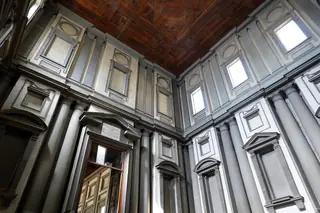
Selected because its compressed vestibule and flowing staircase reveal Michelangelo deliberately disrupting classical architecture under Medici patronage.

~45 min here·4 chapters
The Man Who Broke the Rules on Purpose

Michelangelo approached the Laurentian Library not as a dutiful architect following convention, but as a sculptor who treated walls like raw material — deliberately inverting classical rules to create psychological tension.

What the Staircase Was Actually Saying

The famous triple-ramp staircase — designed by Michelangelo but built by Bartolomeo Ammannati in 1559 — was described by Michelangelo himself as coming back to him "like a dream," and its convex oval steps have no classical precedent; it is one of the founding moments of Mannerist architecture.

The Reading Room and the Collection Behind It

The reading room — 46 meters long, with 88 carved wooden desks designed by Michelangelo — was built to house one of Europe's great manuscript collections, assembled over generations by the Medici, beginning with Cosimo de' Medici's agents scouring monasteries from England to Constantinople.

🔓
Unlock 1 more chapters in the app
Get the app
Piazza della Signoria
04

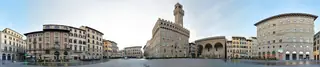
Piazza della Signoria

Selected as David's original public setting, where the present replica helps recover the sculpture's republican meaning and its role as political communication.

~30 min here·5 chapters
The Piazza as Florence's Political Stage

The Piazza della Signoria was not merely a public square — it was the arena where Florence's political identity was performed, contested, and physically inscribed in stone and bronze across five centuries.

David's Original Placement and Republican Meaning

Michelangelo's David was placed at the entrance to the Palazzo della Signoria in 1504 by a committee that included Leonardo da Vinci, making it an explicit statement of Florentine republican defiance — not a religious icon but a civic guardian.

Savonarola's Bonfire and Execution Here

The Piazza della Signoria was the site of both Savonarola's Bonfire of the Vanities in 1497 and his execution in 1498 — two acts of public spectacle that show how the same square could be used to project moral authority and then destroy it.

🔓
Unlock 2 more chapters in the app
Get the app
Casa Buonarroti
05

Casa Buonarroti

Selected for Michelangelo's original early reliefs and the revealing story of how his descendants preserved family memory while constructing the legend of the…

~1 hr here·5 chapters
The Property Michelangelo Bought But Never Lived In

Michelangelo purchased the Via Ghibellina properties between 1508 and 1516 as a deliberate act of family ambition — converting artistic income into social respectability — but never actually resided there himself.

A Grandnephew's Lifelong Act of Devotion

Michelangelo Buonarroti the Younger, the artist's grandnephew, transformed the family property into a monument to his ancestor's memory, commissioning elaborate painted rooms and assembling the archive that makes the museum what it is today.

The Teenager Who Competed With Donatello

The Madonna of the Stairs, carved when Michelangelo was approximately 15 to 17 years old, shows him deliberately engaging with — and subverting — the technique of Donatello, the most revered Florentine sculptor of the previous generation.

🔓
Unlock 2 more chapters in the app
Get the app
Basilica di Santa Croce
06

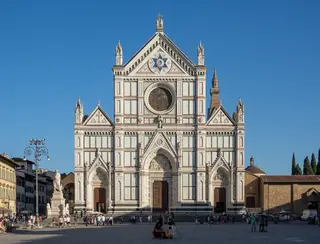
Basilica di Santa Croce

Selected to show how Vasari's monument, Michelangelo's disputed burial, and later national memory allowed Florence to claim the artist as one of its defining…

~2 hrs here·5 chapters
The Body Smuggled Out of Rome

Michelangelo died in Rome but was secretly transported back to Florence by his nephew, disguised as merchant goods — because both cities wanted him.

Vasari's Monument and What It Argues

Giorgio Vasari designed Michelangelo's tomb in 1570 as a deliberate argument — three arts mourning their master — and it was built by the same man who wrote Michelangelo into legend.

The Basilica as Florence's Hall of Fame

Santa Croce's 115-meter nave became, over centuries, a deliberate national pantheon — housing Galileo, Machiavelli, and Michelangelo — and the nineteenth century turned that into explicit political mythology.

🔓
Unlock 2 more chapters in the app
Get the app
Piazzale Michelangelo
07

Piazzale Michelangelo

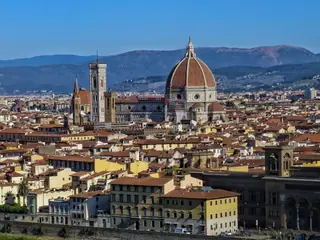
Selected as the tour's culminating viewpoint, where a bronze David replica and the engineered panorama show Michelangelo transformed into a symbol of Florence…

~30 min here·4 chapters
A Hilltop Built for a Capital City

Piazzale Michelangelo was created in 1869 as part of a massive urban modernization drive triggered by Florence's brief, unlikely role as Italy's national capital.

Poggi's Road and the View He Engineered

The Viale dei Colli — the scenic winding road leading up to the piazzale — was a deliberate feat of landscape urbanism, designed to frame Florence's historic skyline as a spectacle.

Why Michelangelo's Name Is on This Square

The choice to name the piazzale after Michelangelo — and to fill it with bronze replicas of his most iconic sculptures — was a deliberate act of civic identity-building, transforming a political project into a cultural monument.

🔓
Unlock 1 more chapters in the app
Get the app

FAQ

How long does this route take?

The audio narration is 68:01 in total. If you pause to look around and take photos, budget 8 hrs. You can pause and resume any time — including the next day.

Is the tour narrated in my language?

This version is narrated in English by rrawi. Other language versions may be available — check the language switcher on this page.

Can I listen without an internet connection?

Yes. This self-guided audio tour works fully offline — download it in the rrawi app before you set off, and GPS automatically triggers the next chapter as you walk. No signal needed.

Do I have to start from the first stop?

No — you can start or jump to any stop in the app. The route works in order, but each stop stands on its own if you need to skip.

What does the free part include?

Different tours offer different free preview chapters depending on the content. Download the rrawi app and subscribe to a City Pass to unlock all 32 chapters and experience the full route.

Ready to walk Florence?

Download rrawi and let rrawi walk with you.

Walk with the app
First chapter at each stop is free
Get the app